Apples Silent AI Tax: How a Billion Devices Become the Worlds Most Powerful Revenue Checkpoint
rall.philipp@gmail.com
Algorithmic Synthesis Pipeline
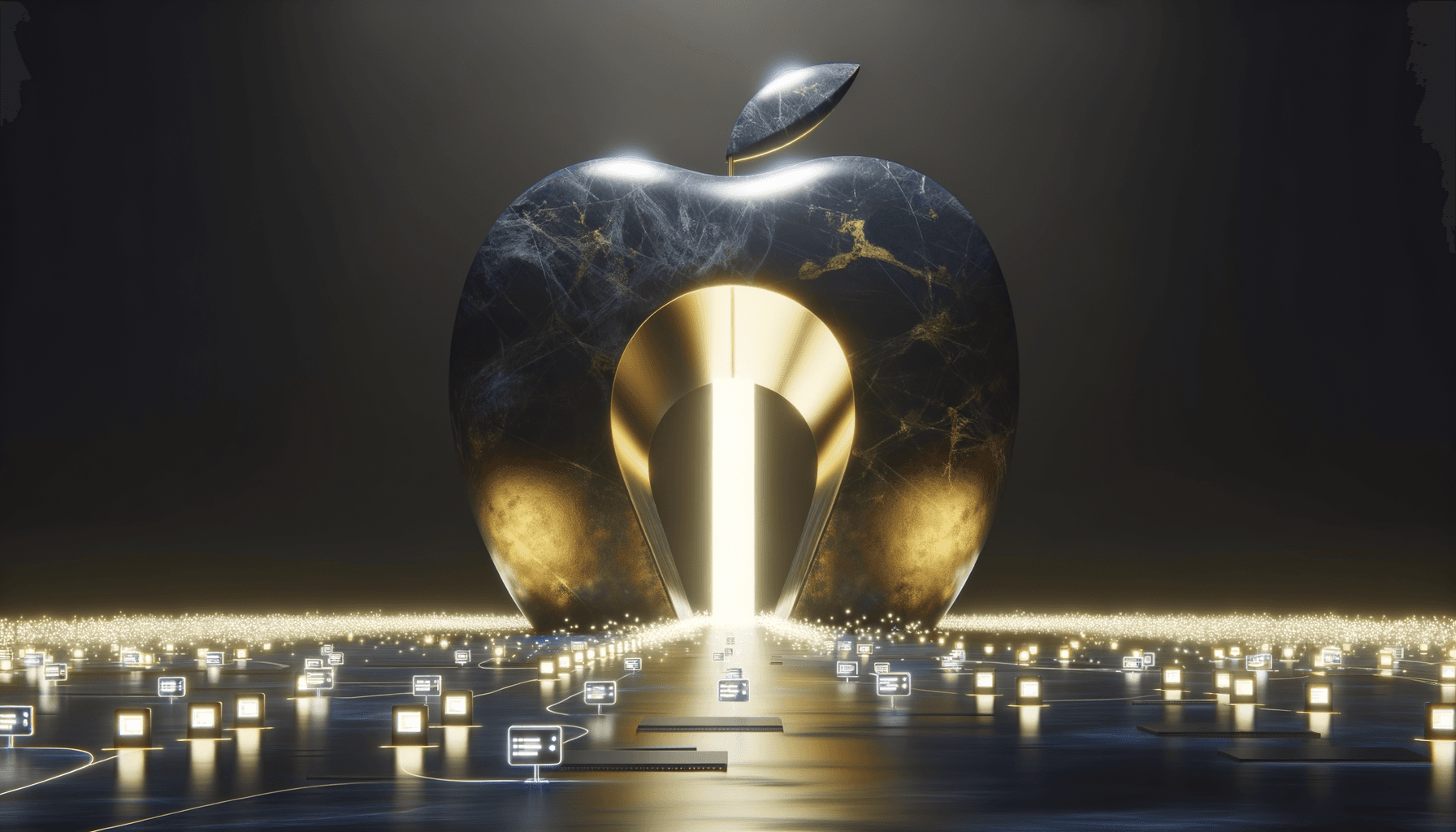
In the summer of 2024, Apple stood on a stage at its Worldwide Developers Conference and announced something that, on the surface, looked like a concession. The company that had long insisted on controlling every layer of its ecosystem — hardware, software, services — was inviting OpenAI’s ChatGPT directly into its operating system. To some, it looked like Apple admitting it had fallen behind in the AI race. To others, it looked like something else entirely: a toll booth opening for business.
Apple doesn’t need to win the AI model war. It needs to own the road.
The Most Valuable Audience in Technology
Any serious analysis of Apple’s AI strategy has to begin not with algorithms or data centers, but with people. According to Apple CFO Luca Maestri on the company’s Q1 2024 earnings call, Apple’s active installed base had surpassed 2.2 billion devices globally — a figure that includes more than 1.2 billion active iPhones, a number management has described as sitting at an „all-time high.“ These aren’t passive users. Research consistently shows that iPhone users skew toward higher income brackets and higher average revenue per user compared to their Android counterparts, a demographic reality that Apple itself underscores by pointing to record services revenue per user quarter after quarter.
This is the substrate of what might be called Apple’s „silent AI tax.“ The company doesn’t need to charge users a visible fee for artificial intelligence. It simply needs to sit between AI providers and the most commercially attractive digital audience on the planet — and let the economics do the rest.
A Proven Playbook: The Services Precedent
Apple has done this before. Its Services business — encompassing the App Store, Apple Pay, iCloud, Apple TV+, and a constellation of subscriptions — generated a record $23.1 billion in revenue in Q1 2024 alone, up from $20.8 billion in the same quarter a year earlier, according to Apple’s earnings release and Form 10-Q for the quarter ended December 30, 2023. Services now represent roughly one-fifth to one-quarter of Apple’s total revenue depending on the quarter, and carry significantly higher margins than hardware, a mix shift Apple’s management has openly credited for boosting overall gross margins.
The business logic is elegant and well-rehearsed: Apple creates the platform, sets the rules, and takes a cut. For most of its App Store history, that cut has been 30 percent on paid apps and in-app purchases, reduced to 15 percent for small developers and for subscriptions after the first year. Apple doesn’t need to make the apps. It simply needs to control who gets to distribute them — and on what terms.
AI is shaping up to follow the same structural logic, with the potential for even greater leverage. Unlike individual apps, AI is increasingly woven into the operating system itself, which means the „distribution“ Apple controls is not just an app store shelf — it’s the interface layer through which users experience intelligence itself.
The Google Deal: A Window Into What „Default“ Is Worth
Perhaps the clearest window into what Apple’s AI gateway position could eventually be worth is the company’s arrangement with Google Search — a deal that became a focal point of the U.S. Department of Justice’s antitrust case against Google. Court proceedings revealed that Google pays Apple an estimated $18 to $20 billion or more annually simply to remain the default search engine on Safari. That figure — staggering in its own right — is payment not for a product, not for advertising, not for content, but purely for placement. For the privilege of being the default answer when an Apple user wants to find something.
If a search engine is worth that kind of annual tribute for default status on Apple devices, the question worth asking is: what is a default AI model worth? The answer, as AI becomes the primary interface through which people access information, complete tasks, and make decisions, could dwarf the Google search arrangement entirely.
Apple Intelligence: Orchestrator, Not Competitor
Apple’s 2024 AI announcement made the strategic architecture explicit. Unveiled at WWDC and detailed in an Apple Newsroom release on June 10, 2024, „Apple Intelligence“ is not a single AI model competing with GPT-4 or Gemini. It is a layered system: on-device models running on Apple Silicon handle lighter tasks like summarization and rewriting; a „Private Cloud Compute“ infrastructure routes more intensive queries to Apple-controlled servers; and for tasks that exceed even that, Siri can now hand off to external models — starting with ChatGPT, with Apple explicitly signaling that additional AI providers could follow.
This architecture is not an admission of weakness. It is a deliberate choice to occupy the orchestration layer rather than compete in the expensive, capital-intensive frontier model race being run by OpenAI, Google, and Anthropic. Apple is not trying to out-spend those companies on GPU clusters and training runs. It is positioning itself as the system that decides which model a user reaches, when, and under what conditions — with user consent flowing through Apple’s own privacy framework and data remaining, as far as possible, within Apple’s controlled environment.
As Seeking Alpha’s analysis of Apple’s AI positioning has noted, this approach allows Apple to monetize AI through services and ecosystem engagement rather than hardware alone — deepening consumer lock-in while avoiding the balance sheet risks of frontier model development.
The Regulatory Shadow Over the Toll Booth
Apple’s ability to extract economic value from platform control has not gone uncontested. The company’s App Store model has faced sustained legal and regulatory challenges that offer a cautionary counterpoint to any assumption that the AI toll booth will operate without friction.
In the U.S., Epic Games‘ multi-year antitrust battle against Apple largely upheld the company’s right to control iOS distribution, though the district court required Apple to allow developers to direct users toward alternative payment methods — the so-called anti-steering provision. The Supreme Court declined to hear appeals in early 2024, leaving most of Apple’s core model intact. In Europe, however, the picture is more complicated. The EU’s Digital Markets Act, which formally designated Apple as a „gatekeeper“ in September 2023, requires the company to allow alternative app stores and sideloading in EU markets. By March 2024, the European Commission had opened non-compliance investigations into Apple’s response to those requirements.
The DMA’s implications for AI are still taking shape, but the direction of regulatory travel is clear: European authorities are explicitly suspicious of gatekeeper dynamics, and an AI distribution model that replicates the App Store’s economics will face scrutiny. Apple’s response — as it has been with every previous regulatory challenge — will likely involve the minimum structural concession necessary to satisfy legal requirements while preserving as much economic leverage as possible.
The Hardware Upgrade Cycle, Quietly Reloaded
There is a dimension to Apple’s AI strategy that receives less attention than the services angle but may prove equally significant: hardware. Many of Apple’s most capable Apple Intelligence features require Apple Silicon of a certain generation — specifically, devices with an A17 Pro chip or later, which means, in practical terms, an iPhone 15 Pro or newer. On-device AI processing at the level Apple has architected demands memory bandwidth and neural engine performance that older hardware simply cannot provide.
This creates a second, less visible revenue mechanism. Users who want the full Apple Intelligence experience are nudged — not forced, but nudged — toward upgrading their devices. In a smartphone market where upgrade cycles have been lengthening for years as hardware improvements became more incremental, AI represents a genuinely compelling reason to replace a device that still works perfectly well. Apple doesn’t need to advertise this. The feature gates speak for themselves.
A Tax by Any Other Name
No Apple user will ever see a line item on their bill reading „AI gateway fee.“ That is precisely what makes the model so durable. The toll Apple collects on the AI era will be embedded in App Store commissions on AI-powered applications, in the implicit value exchanged when AI providers pay — in cash, in favorable terms, or in strategic concessions — for privileged access to Apple’s ecosystem, in hardware upgrade revenue driven by AI feature requirements, and in the deepened services engagement that AI-powered Siri and system features are designed to generate.
What Apple has understood, perhaps better than any other company in the industry, is that the most profitable position in a platform economy is rarely the one building the most impressive technology. It is the one controlling access to the most valuable users. With 2.2 billion active devices, margins that are the envy of the industry, and a track record of converting platform control into recurring, high-margin revenue, Apple has quietly positioned itself at the most important chokepoint in artificial intelligence — not by racing to the frontier, but by owning the gate in front of it.
The AI companies spending billions training ever-larger models may be building the engines. Apple is building the road — and collecting the tolls.
Want to dig deeper into BECOME?
Check out our fully automated, 30-page fundamental deep dive for BECOME.
View Full Analysis